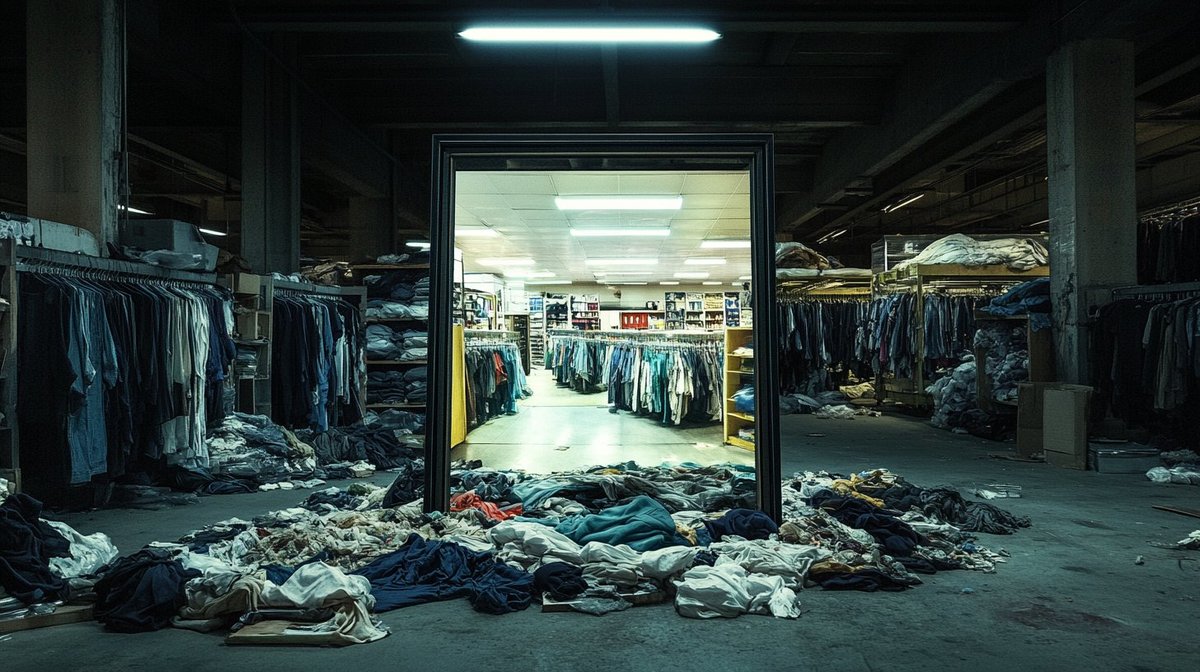
Sustainability has been on a long adventure. We wandered into a Wonderland of data structures, frameworks, and methodologies, all of it meant to lead us toward real impact. Years in, the data has become the destination. The impact is no longer being asked about.
Two specific gaps make this worse. The data we are waiting for, bullet-proof product traceability from point of sale through to point of recovery, does not yet exist anywhere, and Digital Product Passports are not going to deliver it on the timeline being assumed. At the same time, the data that would actually move a boardroom, customer participation, is missing from almost every emerging standard. Customer information is what turns a sustainability programme from a compliance line into a contribution line. We are about to spend years measuring the wrong thing very precisely while the data that wins rooms goes uncaptured.
The article uses Lewis Carroll's cast to make sense of how we got here. The Cheshire Cat is the figure who asks the inconvenient question. The Queen of Hearts is the spectre of being labelled a greenwasher. The Mad Hatter's tea party is the standards apparatus that never finishes. We use the US healthcare system as the cautionary parallel. The Cat that pointed at the missing customer participation data this year arrived as a SHEIN consumer survey. We did not want it to be. That is part of why it counts.
The road only matters if you know the destination
In Lewis Carroll's Alice in Wonderland, Alice asks the Cheshire Cat which way she should go. The Cat says it depends on where she wants to get to. Alice says she does not much care. The Cat tells her that in that case, it does not matter which way she goes.
Sustainability has been on a long adventure. We are years into building data infrastructure that was supposed to enable real impact. The infrastructure has become the work. The destination has receded so far we are no longer asked about it. We are asked which framework the data should align with, which methodology, which emerging standard. Nobody asks where this road is taking us.
The destination was supposed to be real impact. Customers actually participating. Products actually staying in use. Materials actually returning to systems that loop. Somewhere on the way, the data became the destination, and the destination has been quietly forgotten.
The data was supposed to be the road. Somewhere on the way, the data became the destination.
The Queen of Hearts and her quiet court
The reason we keep going further is fear. Sustainability has been so afraid of being called a greenwasher that the safest move is to make no claim at all.
The Queen of Hearts in our story is the threat of being labelled a greenwasher. She does not investigate. She does not weigh evidence. She simply shouts off with their heads at anyone who makes a claim she does not approve of. The threat is enough. Most of her court learn to keep quiet.
Greenwashing fear was meant to discipline the industry. It was meant to stop careless marketing and force companies to back up what they said. It worked. The problem is that the data we are now asked to back up our claims with does not exist in the form we are being asked to produce. So sustainability has spent the last several years getting better at not being attackable, which is a different goal from getting better at being effective.
From where the customer is standing, the result is hard to tell apart from a sector that did not care.
We have been getting better at not being attackable. That is a different goal from getting better at being effective.
The data we are waiting for, and the data we are not
Two specific gaps are worth making explicit, because most of the abstract anxiety in this conversation comes from confusing them.
The first gap is traceability. Bullet-proof product-level traceability, from the moment a product leaves a store to the moment it is recovered, repaired, resold, or recycled, is the data many in the field are waiting for. It does not yet exist anywhere at meaningful scale. Digital Product Passports are widely assumed to be the solution. They will be valuable for compliance and regulatory purposes when they arrive. But it is worth being honest about the timeline. Textile DPP requirements under ESPR are expected to apply from around 2027 at the earliest, with footwear and other categories following later, and retroactive coverage of products already on the market remaining uncertain. Any strategy that depends on bullet-proof point-to-point traceability across an existing product base is, in practice, waiting indefinitely.
The second gap is more important and gets less airtime. Customer participation is the data that would actually prove circularity is working. Did the customer return the product. Did they come back. Did they tell a friend. Did the take-back programme make the brand more attractive on the high street, or less. Did the same euro produce a marketing outcome and an environmental outcome on the same scorecard. These are the questions a retail board would ask of any other in-store programme. They are barely present in any sustainability standard being designed today.
This matters more than the traceability gap because it is the data that wins rooms. I have written before about the meeting where sustainability gets its slot, the room goes polite, and someone says great progress before the conversation moves on to pipeline and margin. Compliance data, by itself, does not change that meeting. It cannot. It does not connect to any number the rest of the business is accountable for. Customer information does. Verified email addresses, returning customers, second visits, basket-size lifts on the trip back into the store, lower acquisition costs than the channel they were going to spend on instead. That is data a CFO leans forward for. That is the data that turns a sustainability programme from a compliance line into a contribution line.
So we are waiting for traceability data that does not yet exist, while ignoring participation data that already does, and that already does the one thing the rest of the apparatus cannot. It earns a permanent seat at the table.
Compliance data does not change a boardroom meeting. Customer data does. That is the data that turns sustainability from a compliance line into a contribution line.
Other industries fell into this hole. They never climbed out.
This is not the first time an industry has confused building data infrastructure with delivering the outcome it was meant to enable. Healthcare in the United States is the cleanest example, and it is the one we should be looking at most carefully right now.
In 2009 the US passed the HITECH Act. Around twenty-seven billion dollars in federal incentives went into electronic health records. The goal was simple. Better patient outcomes through better data. By 2017, ninety-six percent of US hospitals had adopted electronic records. The money worked.
HITECH did deliver real things. Reduced medication errors. Improved chronic-care monitoring. A foundation for clinical research. The narrower goal it failed to deliver, seventeen years on, is the one the original case rested on most heavily: interoperability. Hospitals across the United States still send each other faxes when they need to share information about a patient. The standards arrived. The information sharing those standards were meant to enable did not. The structure became the strategy, and the strategy became the cover for the part of the outcome that proved hardest to deliver.
This is the Mad Hatter's tea party at industrial scale. The cups keep getting washed. The chairs keep getting reset. The methodologies keep getting refined. Each iteration arrives with the conviction that this time the structure will deliver what the previous version did not. Nobody at the table is asking what the table is for, because asking would end the party.
The Cheshire Cat we didn't know we needed
The Cheshire Cat is the figure in Wonderland who asks the inconvenient question and vanishes before anyone can argue. He is not heroic. He is not kind. He is just right at the wrong moment, in the wrong form, from the wrong direction.
The Cat that sustainability got this year arrived as a SHEIN consumer survey. A month ago I wrote about that report. Fifteen thousand four hundred and sixty-one consumers across twenty-one markets were asked what changes they wanted from the brands they buy from. Forty-three percent said physical take-back bins in stores. Digital product passports came last in their list at fifteen percent. The survey did the one thing the standards apparatus has not done. It put a number on customer participation as the thing consumers themselves think matters most.
The piece I wrote at the time was straightforward. Most of the credible players would dismiss the data because of the source. I asked readers to engage with the evidence anyway.
The reaction the article received was instructive in a way I had not fully expected. Many of the rebuttals were thoughtful, and a recurring strand of them rested on the same logic. SHEIN's own sustainability practices fall short, therefore the consumer evidence they gathered should not change anyone's behaviour. That logic is hard to argue with on its face. It is also, on inspection, the same logic perfectionism uses everywhere else in this article. "Yes but the source is not credible" is the same shape as "yes but the data is not yet good enough". Both give a respectable reason not to act on what is already in front of us. I did not see how closely those two sentences resembled each other until the rebuttals were sitting next to each other.
Two things can be true at once. SHEIN's practices deserve criticism. The credible players also need to act on consumer evidence they did not gather themselves, especially when that evidence shines a light on the metric the rest of the field has stopped measuring. The Cat rarely arrives in the form we wanted. That is part of how we know it is the Cat.
"Yes but the source is not credible" is the same shape as "yes but the data is not yet good enough". Both give a respectable reason not to act on what is in front of us.
The way back to the destination
None of this is anti-data. The data has to matter or it does not count. The problem is the order, the fear, and the metrics being measured.
The sharpest answer to the Queen of Hearts is not perfection. It is visible, ongoing, honest action with the data being collected as you go. The harder it is to attack a company for not doing anything, the less the greenwashing accusation lands. Movement is its own defence.
Action that can be measured
I met Jurgen Leo Foley recently. He is a triathlete and coach in Switzerland, and a co-founder of ReBOOT alongside John Hendren. ReBOOT collects running shoes from the Swiss athlete community and gets them to athletes in South Africa who need shoes to train in. A container arrived recently. Shoes that were not being worn are now on feet that needed them.
Jurgen and John did not wait for a perfect dataset. They did not commission a chain-of-custody methodology. They found shoes, found feet, and put them in a container.
What did he measure? Not the carbon footprint of the shipping. Not the chemical composition of the foam. He measured participation. Athletes who got shoes. Donors who came back the next year. The story he could tell to the next group of donors that made them want to be part of it. That is the kind of measurement that funds the next container.
The question
The Cheshire Cat told Alice the road only matters if you know where you want to get to. The destination was supposed to be real impact. The road we are on does not lead there as quickly as we hoped. The fear that prevents us from taking a different road is the fear that ensures we never arrive.
If you wrote down where you are trying to get to, what would you change about the road you are on?